Nature's Neighborhoods: Exploring Communities and Ecosystems
Jump to...
-
Learning Experiences
experiences, activities, and lessons that empower learners
-
Final Products
products, materials, and/or deliverables
-
Learning Outcomes
benchmarks, competencies, standards covered
-
Resources and Places
Books, community assets, links
Why This Unit?
Guiding Questions
- How do living things support one another in a community?
- What is an ecosystem?
- How are communities and ecosystems connected?
- What kinds of communities exist within ecosystems?
- What are the different kinds of impacts?
- How can we protect our ecosystems?
- How does protecting our local ecosystem affect the greater community?
Learning Experiences
Stage One
Discover, Play, Hook
Stage Two
Inquiry, Exploration, Observation
Stage Three
Sharing the Learning
Stage One: Discover, Play, Hook
- Explore Indigenous knowledge through videos and picture books.
- Book Suggestion: In The Three Sisters Garden: Native American Stories and Seasonal Activities for the Curious Child by Joanne Denneek
- Book Suggestion: Keepunumuk: Weeâchumun’s Thanksgiving Story by Danielle Greendeer, Anthony Perry, and Alexis Bunten
- Video Suggestion: “When Ancient Wisdom Beats Modern Industry”
- Video Suggestion: “Three Sisters: Companion Planting of North American Indigenous Peoples”
- Examples of discussion questions:
- How do plants and people depend on one another?
- How did Indigenous communities use their knowledge of the natural world to grow food and support their communities?
- How can we help care for the ecosystems that provide us with food and other resources
- Harvest the crops from the Three Sisters Garden that the previous year had planted.
- Have students research and write recipes using vegetables harvested in the Three Sisters Garden (see recommendations under companion resources in this lesson plan from National Agriculture in the Classroom)
- The whole class discusses and selects a recipe to make together
- Bring in parent volunteers to help with cooking for more community engagement.
- Extension: Students compile a series of recipes using corns, bean, and or squash and collaboratively make a recipe book
- Discuss how human communities thrive when utilizing their ecosystem.
▪ Examples of discussion questions (some repeated from above)- How do people depend on their local environment for food, shelter, and other resources?
- How did Indigenous communities use their knowledge of the natural world to grow food and support their communities
- Why did Indigenous communities plant corn, beans, and squash together? How did this benefit their communities
- How can people use natural resources while also protecting the environment?
- What might happen to a community if its local ecosystem changed?
- Discuss how plants trade resources to survive. Under each item, suggest a few questions and/or additional resources to help guide the discussion. Examples of discussion questions (some repeated from above)
- How do corn, beans, and squash help one another grow in a Three Sisters Garden?
- What does each plant provide for the other plants?
- How do the roots, stems, and leaves of these plants help them survive?
- What might happen if we planted only corn, only beans, or only squash? How would that change the garden?
- Revisit this project at the end of the year to replant the corn, beans, and squash. Be sure to research the correct time of year and conditions to plant for your area.
- Additional resources are offered through our Padlet under Day 3: Integration Day – 2nd and 3rd grade
Important notes:
- This activity should be adjusted to culturally relevant activities of indigenous peoples in your area. For more information, consult the Native Land Digital Map resource: https://native-land.ca/maps/native-land
- This experience relies on the continuity of this unit over years, ensuring there are crops ready to be harvested that were planted by the previous class. If this is not the case, see alternative hook activity here.
Stage Two: Inquiry, Exploration, Observation
LEARNING EXPERIENCES for GQ1: How do living things support one another in a community?
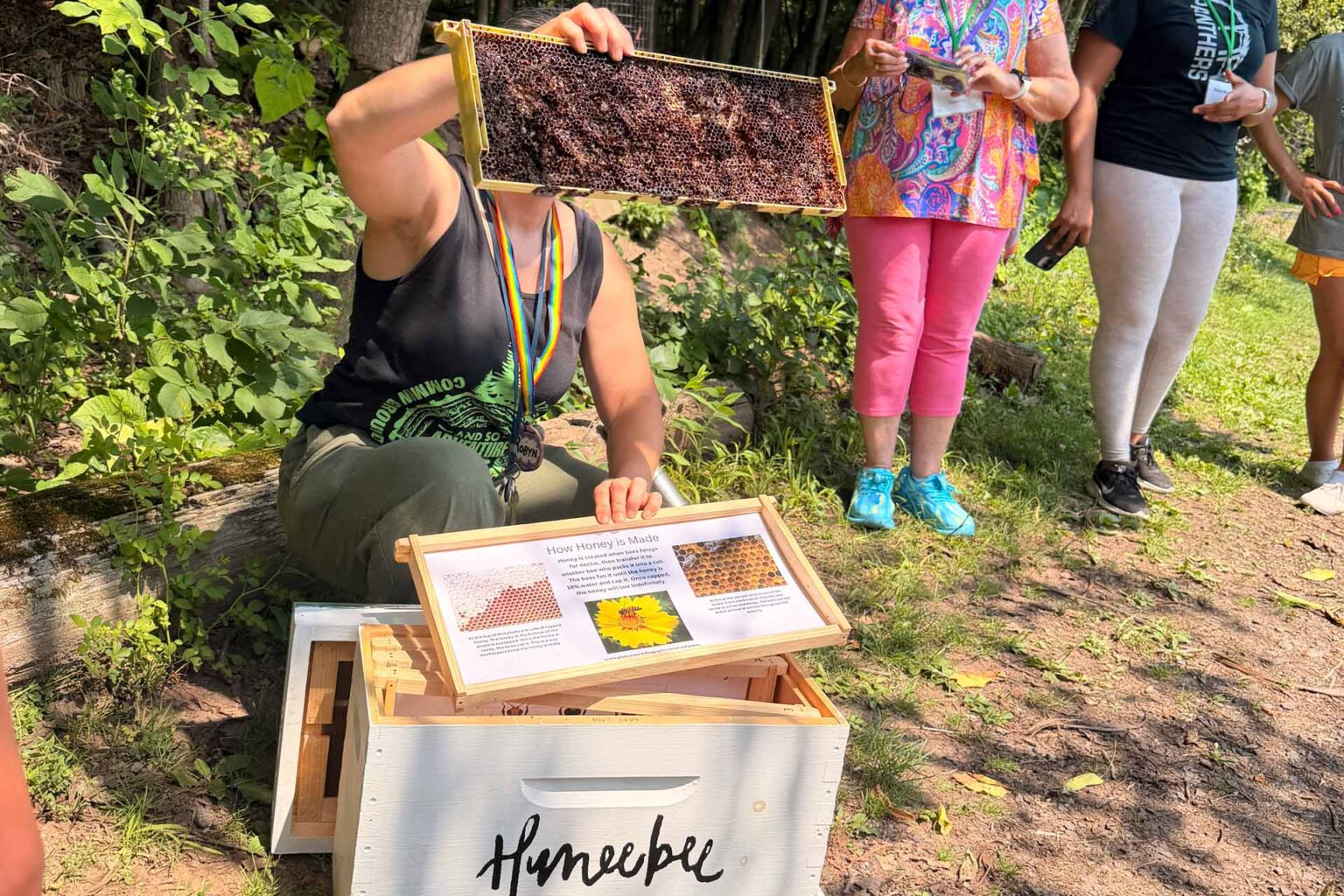
- Learning Experience 1: Explore a beehive
- Travel to a local apiary to learn about the honey bee community and how they work together in order to accomplish their two main jobs: pollination and honey production.
- Book: Honeybee: The Busy Life of Apis Mellifera by Candance Fleming
- Examples of discussion questions:
- How do honeybees work together as a community?
- How do honeybees depend on their ecosystem?
- How do honeybees help their ecosystem?
- What did you learn about honeybees from the book that you were able to observe at the apiary?
- Examples of discussion questions:
- Learning Experience 2: Pollinator game
- Explore how pollinators support life through this game involving fine and gross motor. Further instructions here
- Examples of discussion questions:
- How do pollinators help plants and ecosystems thrive?
- How do environmental changes affect pollinators?
- How do changes in pollination affect human communities?
- What could people do to help bees when their environment becomes more challenging?
- Math extension: counting, multiplying, graphing
LEARNING EXPERIENCES for GQ2: What is an ecosystem?
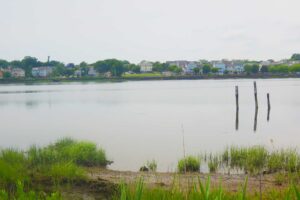
- Learning Experience 1: Field Trip to a local wetland ecosystem
- See here for details on how to use station work to explore the wetland and the various ecosystems found there
- Note: If you do not have access to a wetland, here are a couple of alternatives:
- Explore a local ecosystem in the school yard. Details here→
- Go on a virtual field trip
- The Wetlands institute in New Jersey has a live Osprey Cam as well as many educational resources students can use to explore this salt marsh ecosystem.
- Music extension: Ecosystem song by Gammy Moses – see lyrics here
- ELA extension: Do a writing piece about an animal that students observed on their trip. Osprey example here
- Note: If you do not have access to a wetland, here are a couple of alternatives:
- Learning Experience 2: Wetland Habitat Activity (photos)
- In this playful hands-on activity, students will explore the natural functions of wetlands and learn about their value as a habitat, while developing abstract thinking skills.
- Details here
- ELA extension: metaphor/poetry lesson
- See here for details on how to use station work to explore the wetland and the various ecosystems found there
LEARNING EXPERIENCES for GQ3: What kinds of communities exist within ecosystems?
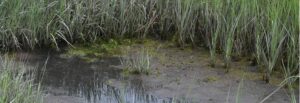
- Learning Experience 1: The Salt Marsh Players Activity
- Each student plays a role of a member in a salt marsh. Through story telling and movement, students learn about the different members of the community that exist within the salt marsh ecosystem and how they interact with one another. (Other Salt Marsh activities and modifications can be found on padlet on DAY 2 Intro to STEAM)
- Learning Experience 2: Go on a bird watching walk!
- Become bird detectives. Provide students with journals where students can draw their findings
- Use field guides for local birds and apps like Merlin to help identify bird species
- Examples of post walk questions:
- What birds did you find?
- Which bird sounds did you like the best?
- How many of each bird did you locate?
- Math extension: counting, graphing
- Learning Experience 3:
- Read Goldfinches by Mary Oliver
- This book is visually, linguistically, and scientifically rich for exploration and can be an entry point into a deeper exploration of one specific type of community – goldfinches – that exist in some ecosystems. See here for some general ideas of directions you could go with this book.
LEARNING EXPERIENCES for GQ4: How are communities and ecosystems connected?
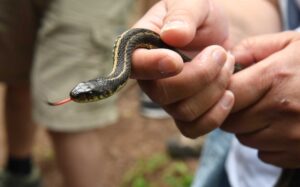
Learning Experience 1: Build your ecosystem- Students collaboratively build a map of the ecosystem they have been exploring. Details here
- Use notes from the local wetland, your school yard ecosystem, or the virtual ecosystem.
- Learning Experience 2: Research organisms from your local wetland
- Learning Experience 3: Book Where Wonder Grows By Xelena Gonzalez & Adriana M. Garcia
- Examples of discussion questions:
- How does spending time in nature make you feel?
- Why do you think people feel a special connection to certain places in nature?
- ELA extension: Invite students to reflect on a place in nature that is special to them. They could draw or write about the place, explain why it matters to them, and describe how they can help protect it.
- Examples of discussion questions:
- Learning experience 4: Watercolor with nature!
- Details here
- Book suggestion: How to Be a Color Wizard: Forage and Experiment with Natural Art-Making by Jason Logan
- Book suggestion: The Modern Natural Dyer: A Comprehensive Guide to Dyeing Silk, Wool, Linen, and Cotton at Home by Kristine Vejar
- Examples of discussion questions:
- What resources can people find in their local environment that can be used to create things?
- Why would this knowledge be valuable to a community?
- What other things do we use every day that come from ecosystems?
- How are the Three Sisters and natural inks two different examples of communities relying on plants?
- Examples of discussion questions:
LEARNING EXPERIENCES for GQ5: What are the different kinds of impacts humans make on their environments?
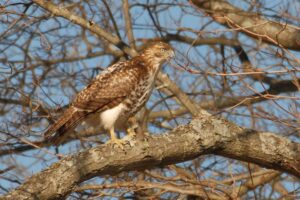
- Learning Experience 1: Learn more about someone that had a local impact in the community
- In the case of New Haven, the local preserve visited in the field trip to learn about the salt marsh ecosystem is called The Quinnipiac Meadows Eugene B. Fargeorge Nature Preserve, named in Eugene’s honor due to the impact he had on wetland preservation and the Fairhaven community
- Students read and discuss the article “100 Years Later, Eugene Fargeorge’s Fair Haven Survives, & Thrives”, published on a local newspaper
- Examples of discussion questions:
- What did Eugene notice about his community that he wanted to change or protect?
- What impact did Eugene Fargeorge have on the Fair Haven community?
- What might Fair Haven look like today if Eugene had not taken action?
- What does Eugene’s story teach us about the ways people can impact their local ecosystem and community?
- Examples of discussion questions:
- Learning Experience 2: Book Common Ground: The Water, Earth, and Air We Share by Molly Bang
- This book will help students build on the notion of impact and expand the concept from a local to a global scale. Details here
LEARNING EXPERIENCES for GQ6: How can we protect our ecosystems?
- Learning Experience 1: Restoring Water with Oysters
- Learn about how the Mashpee Wampanoag tribe in Cape Cod are using oysters to clean their water
- Look at local organizations that are protecting the community such as the Mashpee Wampanoag Tribe Natural Resource Department
- Set up an oyster tank and track water over time and compare the results
- Math extension: graphing, measuring
- Book suggestion: Heroes of the Environment: True Stories of People Who Are Helping Protect our Planet by Harriet Rohmer
- Examples of discussion questions for specific profiles in the story:
- What problem was this person trying to solve?
- What did they do to make a difference?
- What knowledge, resources, or teamwork did they need?
- Who or what was affected by their actions?
- What challenges did they face?
- How did they work with their ecosystem rather than simply taking from it?
- Examples of discussion questions for specific profiles in the story:
- Learning Experience 2: Plankton Biomagnification Game (tag game) – details here
- Music: biomagnification song lyrics here
LEARNING EXPERIENCES for GQ7: How does protecting our local ecosystem affect the greater community?
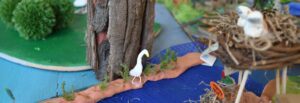
- Learning Experience 1: Book Olivia’s Birds By Olivia Bouler
- Examples of discussion questions:
- What are the effects on our local plants, animals, and human communities when ecosystems are not protected? How about globally?
- What were some of the ways that Olivia, an 11 year-old child, helped the birds?
- How might we help preserve vital animal species? What actions might we take?
- Learning Experience 2: Get involved in the greater community!
- Inspired by Olivia’s birds (or another book that inspires action and preservation) find a local animal rehabilitation center – example here
- Want to make global connections? Explore global conservation efforts that relate to the ecosystem, animal or plant species that have come up in your study – example here
Stage Three: Sharing the Learning
- Students plan numerous locations for a pollinator garden.
- Students research native plants that support local pollinators
- Students research scout locations given sunlight, soil and space for the chosen plants
- Students research where to find seeds or seedlings/saplings of the chosen plants
- Students plant them!
- Students register their garden on the Pollinator Pathway Map
- Students create signage at the pollinator gardens to educate the local community on their purpose and to protect the gardens from being picked at or dug up.
- Students return to locations at various points for observations and data collection
- Record the date, time, and location
- Choose a plant to watch
- Start a timer (aim for at least 5 minutes) and count every visit from a pollinator to your flower.
- Contribute to the science community by adding your data to something like The Great Sunflower Project. Examples of observations and data collection
- Students research native plants that support local pollinators
Principles of Place-Based Learning:
- Community as classroom
- Inquiry-Based
- Design thinking
- Local-to-global
- Learner-centered
- Interdisciplinary
Principles of Play-Based Learning:
- Active
- Engaged
- Meaningful
- Social
- Iterative
- Joyful
Portrait of a Graduate:
- Synergistic Collaborator
- Effective Communicator
- Critical Thinker
- Self-Directed Learner
- Global Citizen
Seedlings-Based Learning:
- Grounded in Place
- Developmentally Appropriate
- Integrative Learning
- Community Partners & Mentors
- Intentional Reflection
Learning Outcomes
- Grade 2
- 2-LS2-1: Plan and conduct an investigation to determine if plants need sunlight and water to grow.
- 2-LS2-2: Develop a simple model that mimics the function of an animal in dispersing seeds or pollinating plants.
- 2-LS4-1: Make observations of plants and animals to compare the diversity of life in different habitats.
- Grade 3
- 3-LS2-1: Construct an argument that some animals form groups that help members survive.
- 3-LS4-3: Construct an argument with evidence that in a particular habitat some organisms can survive well, some survive less well, and some cannot survive at all.
- 3-LS4-4: Make a claim about the merit of a solution to a problem caused when the environment changes and the types of plants and animals that live there may change.
- Grade 2
- RI.2.1: Ask and answer such questions as who, what, where, when, why, and how to demonstrate understanding of key details in a text.
- W.2.2: Write informative/explanatory texts in which they introduce a topic, use facts and definitions to develop points, and provide a concluding statement or section.
- W.2.7: Participate in shared research and writing projects (e.g., read a number of books on a single topic to produce a report; record science observations).
- W.2.8: Recall information from experiences or gather information from provided sources to answer a question.
- SL.2.1: Participate in collaborative conversations with diverse partners about grade 2 topics and texts with peers and adults in small and larger groups.
- Grade 3
- 3.1: Ask and answer questions to demonstrate understanding of a text, referring explicitly to the text as the basis for the answers.
- 3.7: Use information gained from illustrations and the words in a text to demonstrate understanding of the text (e.g., where, when, why, and how key events occur).
- 3.2: Write informative/explanatory texts to examine a topic and convey ideas and information clearly.
- 3.7: Conduct short research projects that build knowledge about a topic.
- 3.8: Recall relevant information from experiences or gather information from print and digital sources; take brief notes on sources and sort evidence into provided categories.
- 3.1: Engage effectively in a range of collaborative discussions with diverse partners on grade 3 topics and texts.
- Grade 2
- MP.2: Reason abstractly and quantitatively.
- MP.4: Model with mathematics.
- MP.5: Use appropriate tools strategically.
- 2.MD.D.10: Draw a picture graph and a bar graph (with a single-unit scale) to represent a data set with up to four categories. Solve simple put-together, take-apart, and compare problems using information presented in a bar graph.
- Grade 3
- 2: Reason abstractly and quantitatively.
- 4: Model with mathematics.
- 5: Use appropriate tools strategically.
- MD.B.3: Draw a scaled picture graph and a scaled bar graph to represent a data set with several categories. Solve one- and two-step “how many more” and “how many less” problems using information presented in scaled bar graphs.
- MD.B.4: Generate measurement data by measuring lengths using rulers marked with halves and fourths of an inch and show the data by making a line plot.
- Grade 2
- 2.Inq.4.e: Identify and explain a range of local, regional, and global problems, and some ways in which people can and are trying to address these problems.
- 2.Civ.6.a: Describe how individuals and groups work interdependently to improve their community.
- 2.Civ.10.a: Compare one’s own perspective about a community issue with that of the perspective of others.
- 2.Geo.1.a: Demonstrate spatial awareness by creating a community map illustrating physical and human-made features (e.g., bodies of water, topography, structures, plant and animal life).
- 2.Geo.4.a: Explain how climate, weather, and environmental characteristics influence the decisions people make in their community.
- Grade 3
- Inq.4.e: Explain the challenges and opportunities, both present and past, in addressing local, regional, and global problems in Connecticut history.
- Civ.6.a: Describe how people benefit from and face challenges working together in various settings to address problems.
- 3.Geo.2.a: Use maps and other visual representations to describe relationships between the locations of places and regions throughout Connecticut and their environmental characteristics.
Final Products
- Three sisters garden in the schoolyard (Hook)
- Grannis Island map (or other relevant ecosystem) (Question 4)
- Salt Marsh character informational cards (Question 4)
- Oyster Tank (Question 6)
- Letters to local preservation center and/or other relevant project to inspire or support preservation efforts (Question 7)
- Pollinator Garden and signage (Stage 3)
Resources and Places
Books
- In The Three Sisters Garden: Native American Stories and Seasonal Activities for the Curious Child by Joanne Denneek
- Honeybee: The Busy Life of Apis Mellifera by Candance Fleming
- Common Ground: The Water, Earth, and Air We Share by Molly Bang
- Where Wonder Grows By Xelena Gonzalez & Adriana M. Garcia
- How to Be a Color Wizard: Forage and Experiment with Natural Art-Making by Jason Logan
- The Modern Natural Dyer: A Comprehensive Guide to Dyeing Silk, Wool, Linen, and Cotton at Home by Kristine Vejar
- Bird Watch by Backpack Explorers
- Local birdwatching guidebooks
- Goldfinches by Mary Oliver
- Heroes of the Environment: True Stories of People Who Are Helping Protect our Planet by Harriet Rohmer
- Olivia’s Birds by Olivia Bouler
- Up in the Garden Down in the Dirt by Kate Messner
Community Assets
- Local Nature Preserve or City Park with a wetland habitat -for this unit, in New Haven CT, we visited the Quinnipiac Meadows Eugene B. Fargeorge Preserve
- Local Apiary – for this unit, we visited the Common Ground High School: an Urban Farm and Environmental Education Center, in New Haven
- Local animal rehabilitation center such as A Place Called Hope: Bird of Prey Rehabilitation Center, in Killington
- Other organizations that may have connections to your ecosystem of study such as:
Local Connections
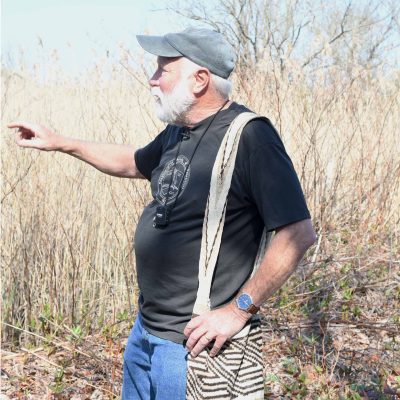
- Jim Powers, historian, author, educator, and archaeologist
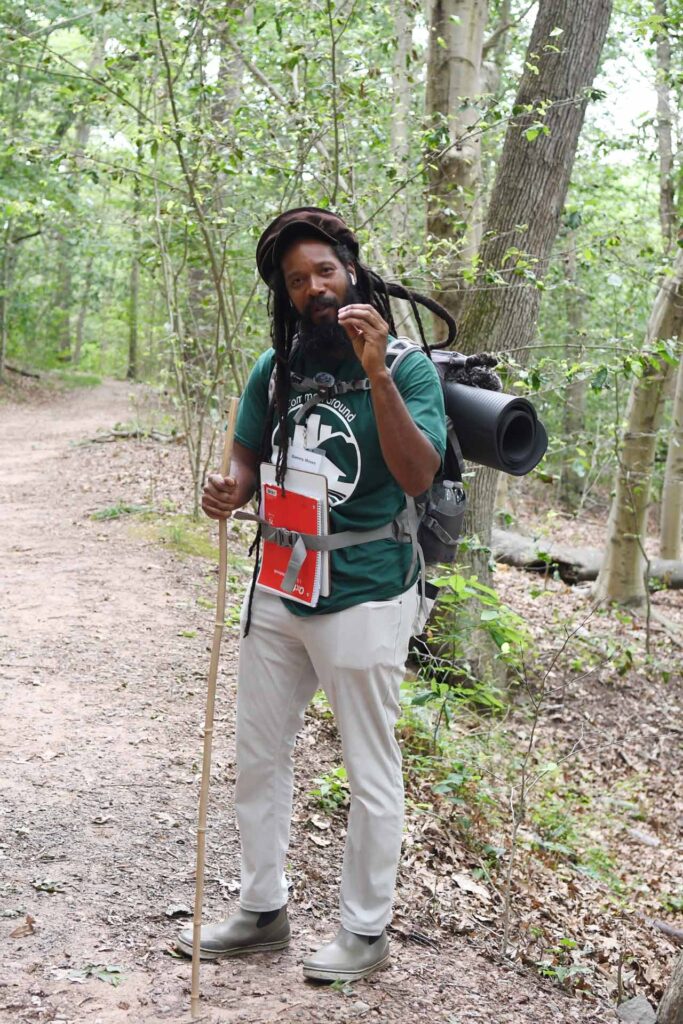
- Gammy Moses, local outdoor educator, musician, and community leader
- Mashpee Wampanoag Tribe
- A Place Called Hope, A Rehabilitation and Education Center for Birds of Prey
This unit was developed by these inspiring educators:
More Place-Based Learning Units

River Keepers: Exploring the Quinnipiac River Ecosystem
Kindergarten/First Grade This unit invites students to step into their local environment to become real-life river scientists and caretakers. They investigate how the river functions and discover how local wildlife—such as burrowing fiddler crabs, soaring osprey, and hardworking beavers-—depend on a healthy river habitat.
Home Sweet Home: Exploring Animal Habitats
Pre-Kindergarten (ages 3-5 years)
In this unit, students will explore different types of homes, and why each home is important to its inhabitants. They will have the opportunity to observe, compare, and construct different types of homes, and begin thinking about how a home is part of a greater community.